
10 Best Multimeters for Electricians, Engineers and DIY (2026)
As an Amazon Associate, Engineer Warehouse earns from qualifying purchases. That does not change what you pay. Last updated on November 17, 2026
A digital multimeter measures voltage, current and resistance, checks continuity and diodes, and on many models reads capacitance, frequency and temperature too. It is the basic diagnostic tool for electricians, HVAC technicians, engineers and anyone who works on wiring or electronics.
The most important thing is safety: choose a meter with the right CAT rating for the circuits you work on, and buy from a brand whose ratings you can trust. Below are ten current meters, starting with the ones we would buy first.
Best multimeter for electricians
- Built-in non-contact voltage detection
- True-RMS with low-impedance (LoZ) mode
- Thousands of Amazon reviews
Best general-purpose professional meter
- True-RMS
- Measures voltage, current, resistance, capacitance and frequency
- Fluke build and safety ratings
Best professional meter for the money
- Auto-ranging, true-RMS
- 600V AC/DC, 10A AC/DC current
- From Klein Tools, an electrician’s brand
Best multimeter for HVAC/R work
- True-RMS clamp meter
- Temperature and capacitance
- Compact HVAC/R design
Best simple Fluke for electrical work
- True-RMS
- Low-impedance mode
- Streamlined electrician’s feature set
Best compact Fluke
- Compact handheld
- AC/DC voltage and current
- Thousands of Amazon reviews
Best expandable HVAC meter
- Manual-ranging stick meter
- Accepts Fieldpiece accessory heads
- 400A clamp and non-contact voltage
Best value meter for electronics engineers
- Brymen build with EEVblog branding
- Popular with electronics engineers and hobbyists
- Well regarded for safety design
Best low-cost meter for home use
- Manual-ranging
- 600V AC/DC voltage
- Tests batteries
Best basic meter for occasional use
- Eight functions
- Digital display
- Simple operation
The best multimeters, reviewed

Best multimeter for electricians. Our rating: 5.0/5.0
The Fluke 117 is the meter we would hand to a working electrician. It adds non-contact voltage detection and a low-impedance mode that helps rule out ghost voltages, both of which save time on real jobs.
Fluke’s build quality and safety ratings are the industry benchmark, which is why so many electricians carry one for years.

Best general-purpose professional meter. Our rating: 4.9/5.0
The Fluke 115 is the field-service sibling of the 117. It drops the non-contact voltage detector and LoZ mode but keeps the true-RMS accuracy and Fluke durability.
It is the better choice for technicians and engineers who measure more than building wiring.

Best professional meter for the money. Our rating: 4.8/5.0
Klein Tools has been making electricians’ tools since 1857, and the MM420 is a capable auto-ranging true-RMS meter for much less than a Fluke.
For apprentices and electricians who want a reliable everyday meter without the Fluke price, it is our pick.

Best multimeter for HVAC/R work. Our rating: 4.7/5.0
Fieldpiece builds meters for HVAC and refrigeration technicians. The SC260 combines a clamp for measuring current without breaking the circuit with temperature and capacitance functions for testing motors and capacitors.
If you work on furnaces, condensers and heat pumps, this is a better fit than a general-purpose meter.

Best simple Fluke for electrical work. Our rating: 4.6/5.0
The Fluke 114 focuses on the measurements electricians make most and leaves out current measurement, which some contractors prefer as it removes a common way of damaging a meter.
It is a good choice for building electricians who use a separate clamp meter for current.

Best compact Fluke. Our rating: 4.5/5.0
The Fluke 107 is Fluke’s compact, lower-cost meter. It fits in a pocket and gives you Fluke reliability for general troubleshooting.
It is not true-RMS, so for variable-speed drives and other non-sinusoidal loads, step up to the 115 or 117.

Best expandable HVAC meter. Our rating: 4.4/5.0
The HS33’s stick design and accessory heads let HVAC technicians add measurements such as temperature and pressure as needed.
It is manual-ranging, which some technicians prefer for speed once they are used to it.

Best value meter for electronics engineers. Our rating: 4.3/5.0
The BM235 is made by Brymen and sold through the EEVblog engineering community. It has a strong following among electronics engineers for its build and safety design at a reasonable price.
It is a good alternative to Fluke for lab and bench work.

Best low-cost meter for home use. Our rating: 4.2/5.0
The MM325 is an inexpensive Klein meter for homeowners and DIYers who need to check outlets, batteries and continuity.
Manual ranging means you select the range yourself, which takes a little more thought than an auto-ranging meter.
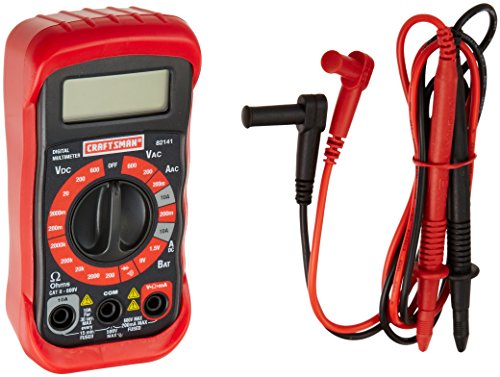
Best basic meter for occasional use. Our rating: 4.1/5.0
A basic Craftsman meter covers voltage, resistance and continuity checks around the house and garage.
For anything beyond occasional use, choose one of the meters above.
How to choose a multimeter
Safety rating
CAT ratings show where a meter can safely be used. CAT III covers building wiring and distribution panels; CAT IV covers service entrances and utility connections. Use a meter rated for the highest category you work on, and buy from a brand whose ratings are independently certified.
True-RMS
A true-RMS meter reads correctly on distorted waveforms from variable-speed drives, LED drivers and electronics. For professional electrical work, it is worth having.
Auto-ranging
Auto-ranging meters pick the range for you, which is faster and reduces mistakes.
Extra functions
Non-contact voltage detection, low-impedance mode, temperature, capacitance and a clamp for current are useful for specific trades. Choose the ones that match your work.
FAQs
Is Fluke worth the money?
For professionals working on live circuits, yes: build quality, accuracy and safety ratings are the main reasons electricians pay more for Fluke. For occasional home use, a Klein meter is enough.
What is the difference between a multimeter and a clamp meter?
A multimeter measures current by being connected into the circuit. A clamp meter measures it by clamping around a wire, which is safer and faster for high currents.
What does true-RMS mean?
It means the meter correctly measures the effective value of AC signals that are not perfect sine waves, which are common in modern electrical systems.
Can I use a multimeter to test an outlet?
Yes. Set it to AC volts and measure between the hot and neutral slots. Follow safe practices and use a meter rated for the circuit.
How we chose
We compared current meters on safety ratings, measurement features and fit for each trade, the track record of the brand and how well established each model is with buyers on Amazon. Our ratings are our own editorial assessment of each model’s features and value. We did not rank on price, which changes often; the buttons above show the current price on Amazon.