
10 Best Metal Lathes for Home Shops and Hobbyists (2026)
As an Amazon Associate, Engineer Warehouse earns from qualifying purchases. That does not change what you pay. Last updated on November 17, 2026
A benchtop metal lathe lets you turn shafts, bushings, spacers and threaded parts from steel, aluminum and brass in a home shop. Mini lathes in the 7 x 12 to 7 x 14 size are where most hobbyists start; 8 x 16 to 10 x 26 machines give you more rigidity and capacity.
Lathe sizes are given as swing (the largest diameter it can turn) by distance between centers (the longest part). Budget machines on Amazon vary a lot in fit and finish, so expect to spend some time adjusting and cleaning a new mini lathe. Below are ten current machines, starting with the ones we would buy first.
Best lathe from an established machine tool brand
- 8-inch swing, 16 inches between centers
- Variable speed
- Includes a milling head
Best larger bench lathe
- 10-inch swing, 26 inches between centers
- Bench-mounted
- Shop Fox, from the Woodstock tool family
Best value mini lathe
- 7 x 14 inch capacity
- 550W variable speed to 2,250 RPM with digital readout
- 3-jaw chuck
Best for threading without change gears
- 8 x 16 inch capacity
- Electronic gearless threading, inch and metric
- Benchtop
Best budget lathe for longer parts
- 8.7 x 29.5 inch capacity
- 1.1 kW motor, variable speed
- Benchtop
Alternative larger budget lathe
- 9 x 30 inch capacity
- 1100W, 0–2,500 RPM variable speed
- Benchtop
Best entry-level mini lathe
- 7 x 12 inch capacity
- 550W variable speed
- Benchtop
Alternative 7 x 14 mini lathe
- 7 x 14 inch capacity
- Variable speed to 2,500 RPM
- Digital readout
Best mini lathe for larger diameters
- 9-inch swing
- Variable speed to 3,000 RPM
- 3-jaw chuck
Best budget lathe with a brushless motor
- 8 x 16 inch capacity
- 900W brushless motor
- Variable speed
The best metal lathes, reviewed

Best lathe from an established machine tool brand. Our rating: 5.0/5.0
Grizzly has sold machine tools to home shops for decades, with US-based support and parts. The G0769 combines an 8 x 16 lathe with a small milling head, so you can turn and mill parts on one machine.
Combination machines involve compromises in rigidity compared with separate machines, but for a small shop with limited space it is a lot of capability from a brand you can get support from.

Best larger bench lathe. Our rating: 4.9/5.0
The Shop Fox M1099 offers more swing and length than mini lathes, which means more rigidity and room for bigger parts.
It is heavy and needs a sturdy bench or stand.

Best value mini lathe. Our rating: 4.8/5.0
VEVOR’s 7 x 14 is the most-reviewed mini lathe on Amazon. It is the classic 7 x 14 design with a digital speed readout.
Like all budget mini lathes, plan to clean off shipping grease, check the gibs and adjust it before precision work.

Best for threading without change gears. Our rating: 4.7/5.0
An electronic leadscrew lets you select thread pitches without swapping change gears, which makes threading much quicker for beginners.
It is a newer design with fewer reviews, so check recent buyer feedback.
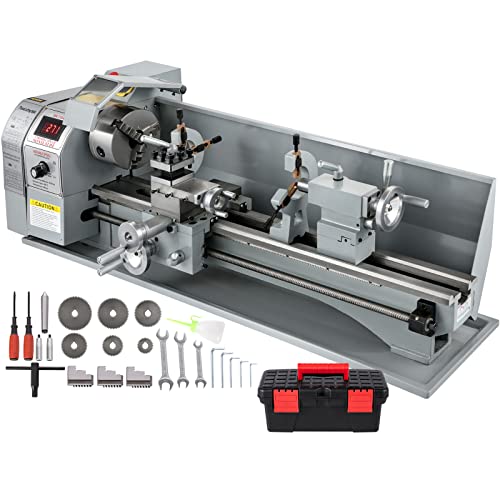
Best budget lathe for longer parts. Our rating: 4.6/5.0
If you need to turn longer shafts, VEVOR’s larger lathe gives you nearly 30 inches between centers.
It is heavy, so plan the bench and lifting before delivery.

Alternative larger budget lathe. Our rating: 4.5/5.0
A comparable 9 x 30 budget lathe to the VEVOR above. Compare included accessories and current reviews before choosing.
Expect to spend time on setup.

Best entry-level mini lathe. Our rating: 4.4/5.0
The 7 x 12 is the smallest common metal lathe size and the cheapest way to start machining.
Its short bed limits part length; the 7 x 14 is usually worth the small extra cost.

Alternative 7 x 14 mini lathe. Our rating: 4.3/5.0
Another 7 x 14 mini lathe on the common design. Compare accessories and seller support with the VEVOR.
Mini lathes from different sellers are often built on the same platform.

Best mini lathe for larger diameters. Our rating: 4.2/5.0
The 9-inch swing lets you turn larger diameters than a 7-inch mini lathe, though the bed is short.
A newer listing; check recent reviews.

Best budget lathe with a brushless motor. Our rating: 4.1/5.0
Brushless motors deliver more torque at low speed than the brushed motors on most mini lathes, which helps with larger diameters and threading.
Check the seller’s support and parts availability before buying.
How to choose a metal lathe
Size
Choose a swing and length that comfortably fit your typical parts. Bigger machines are more rigid, which gives better finishes and allows deeper cuts.
Threading
Most lathes cut threads with change gears. Electronic leadscrews make changing pitch much quicker.
Support and parts
Brands with US support and parts, such as Grizzly and Shop Fox, are easier to live with than unbranded imports.
Budget for tooling
Allow extra for cutting tools, a quick-change tool post, measuring tools, a 4-jaw chuck and a sturdy stand.
Safety
Wear eye protection, never wear gloves or loose clothing near the spindle, and never leave a chuck key in the chuck.
FAQs
What size lathe do I need?
For small parts and learning, a 7 x 14 mini lathe is enough. For more rigidity and larger work, look at 8 x 16 to 10 x 26 machines.
Can a mini lathe cut steel?
Yes, with light cuts and sharp tooling. Mini lathes are less rigid than larger machines, so take shallower passes.
Do I need a mill as well?
Many projects need both. A combination lathe/mill saves space; separate machines are more rigid.
How accurate are budget lathes?
With careful setup and adjustment, a budget mini lathe can hold a few thousandths of an inch. Expect to tune it.
How we chose
We compared current machines on capacity, motor and threading features, brand support and how well established each model is with buyers on Amazon. Our ratings are our own editorial assessment of each model’s features and value. We did not rank on price, which changes often; the buttons above show the current price on Amazon.